
Advancing Environmental Sustainability: Optimizing the Application of Activated Carbon from Sugarcane Trash and Cotton Seed Waste for Methylene Blue Adsorption
الشريط الجانبي للمقالة
محتوى المقالة الرئيسي
الملخص
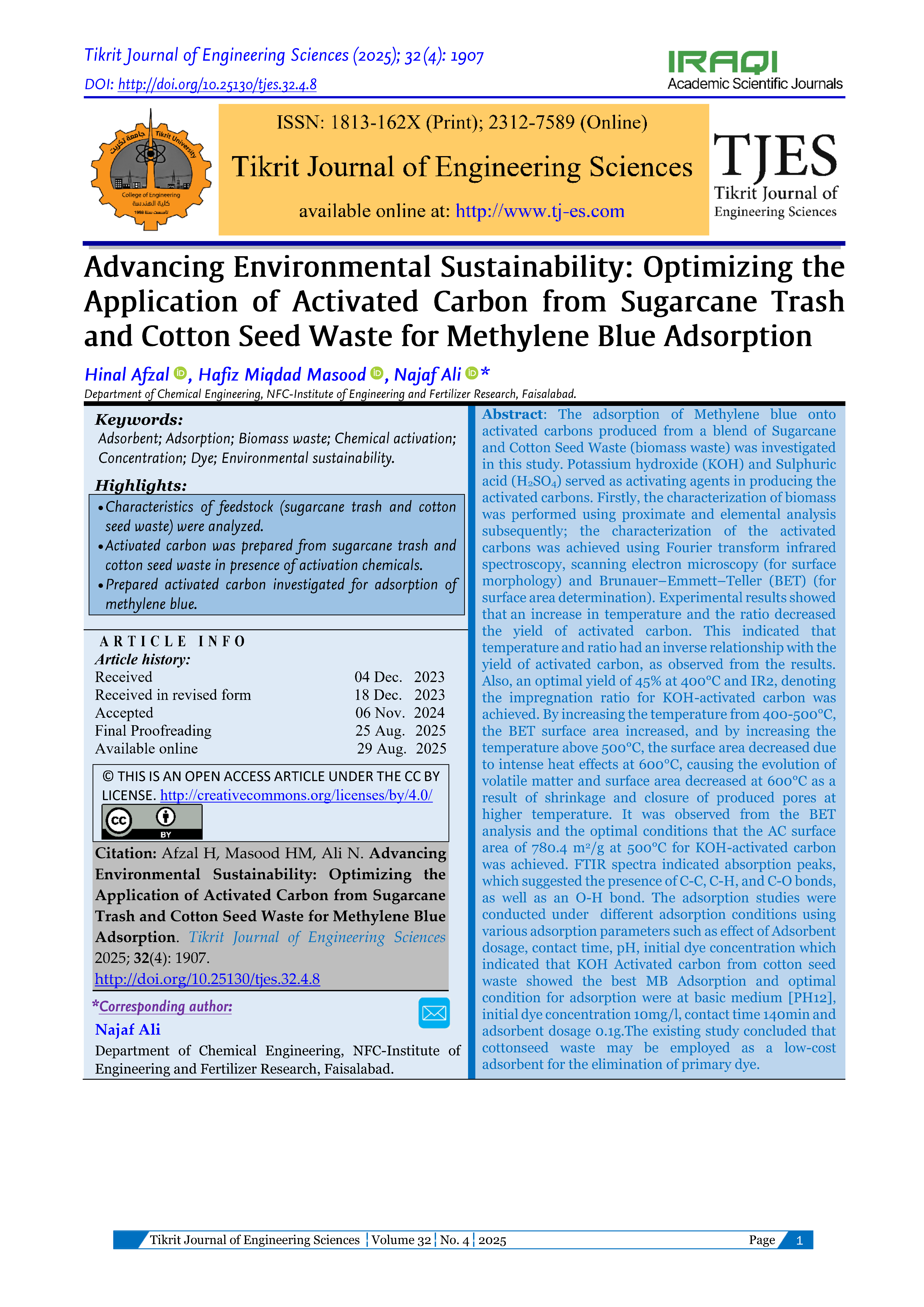
The adsorption of Methylene blue onto activated carbons produced from a blend of Sugarcane and Cotton Seed Waste (biomass waste) was investigated in this study. Potassium hydroxide (KOH) and Sulphuric acid (H2SO4) served as activating agents in producing the activated carbons. Firstly, the characterization of biomass was performed using proximate and elemental analysis subsequently; the characterization of the activated carbons was achieved using Fourier transform infrared spectroscopy, scanning electron microscopy (for surface morphology) and Brunauer–Emmett–Teller (BET) (for surface area determination). Experimental results showed that an increase in temperature and the ratio decreased the yield of activated carbon. This indicated that temperature and ratio had an inverse relationship with the yield of activated carbon, as observed from the results. Also, an optimal yield of 45% at 400°C and IR2, denoting the impregnation ratio for KOH-activated carbon was achieved. By increasing the temperature from 400-500°C, the BET surface area increased, and by increasing the temperature above 500°C, the surface area decreased due to intense heat effects at 600°C, causing the evolution of volatile matter and surface area decreased at 600°C as a result of shrinkage and closure of produced pores at higher temperature. It was observed from the BET analysis and the optimal conditions that the AC surface area of 780.4 m2/g at 500°C for KOH-activated carbon was achieved. FTIR spectra indicated absorption peaks, which suggested the presence of C-C, C-H, and C-O bonds, as well as an O-H bond. The adsorption studies were conducted under different adsorption conditions using various adsorption parameters such as effect of Adsorbent dosage, contact time, pH, initial dye concentration which indicated that KOH Activated carbon from cotton seed waste showed the best MB Adsorption and optimal condition for adsorption were at basic medium [PH12], initial dye concentration 10mg/l, contact time 140min and adsorbent dosage 0.1g.The existing study concluded that cottonseed waste may be employed as a low-cost adsorbent for the elimination of primary dye.
تفاصيل المقالة
القسم

هذا العمل مرخص بموجب Creative Commons Attribution 4.0 International License.
THIS IS AN OPEN ACCESS ARTICLE UNDER THE CC BY LICENSE http://creativecommons.org/licenses/by/4.0/
كيفية الاقتباس


المراجع
Chanzu HA, Onyari JM, Shiundu PM. Biosorption of Malachite Green from Aqueous Solutions onto Polylactide/Spent Brewery Grains Films: Kinetic and Equilibrium Studies. Journal of Polymers and the Environment 2012; 20(3): 665-672.
Chaudhari A. Adsorption Capacity of Activated Carbon Prepared by Chemical Activation of Lignin for the Removal of Methylene Blue Dye. International Journal of Advanced Research in Chemical Science 2015; 2(8): 1-13.
Crini G, Lichtfouse E. Advantages and Disadvantages of Techniques Used for Wastewater Treatment. Environmental Chemistry Letters 2019; 17(1): 145-155.
Donkadokula NY, Kola AK, Naz I, Saroj D. A Review on Advanced Physico-Chemical and Biological Textile Dye Wastewater Treatment Techniques. Reviews in Environmental Science and Bio/Technology 2020; 19(3): 543-560.
El-Shafey EI, Ali SNF, Al-Busafi S, Al-Lawati HA. Preparation and Characterization of Surface Functionalized Activated Carbons from Date Palm Leaflets and Application for Methylene Blue Removal. Journal of Environmental Chemical Engineering 2016; 4(3): 2713-2724.
Feng P, Li J, Wang H, Xu Z. Biomass-Based Activated Carbon and Activators: Preparation of Activated Carbon from Corncob by Chemical Activation with Biomass Pyrolysis Liquids. ACS Omega 2020; 5(37): 24064-24072.
Foo KY, Hameed BH. Porous Structure and Adsorptive Properties of Pineapple Peel Based Activated Carbons Prepared via Microwave Assisted KOH and K2CO3 Activation. Microporous and Mesoporous Materials 2012; 148(1): 191-195.
Ghaedi M, Mazaheri H, Khodadoust S, Hajati S, Purkait MK. Application of Central Composite Design for Simultaneous Removal of Methylene Blue and Pb2+ Ions by Walnut Wood Activated Carbon. Spectrochimica Acta Part A: Molecular and Biomolecular Spectroscopy 2015; 135: 479-490.
Gonawala K, Mehta MJ. Removal of Color from Different Dye Wastewater by Using Ferric Oxide as an Adsorbent. International Journal of Engineering Research and Applications 2014; 4(5): 102-109.
Hadi P, Xu M, Ning C, Sze Ki Lin C, McKay G. A Critical Review on Preparation, Characterization and Utilization of Sludge-Derived Activated Carbons for Wastewater Treatment. Chemical Engineering Journal 2015; 260: 895-906.
Husien S, El-taweel RM, Salim AI, Fahim IS, Said LA, Radwan AG. Review of Activated Carbon Adsorbent Material for Textile Dyes Removal: Preparation, and Modeling. Current Research in Green and Sustainable Chemistry 2022; 5: 100325.
Nasrullah A, Saad B, Bhat AH, Khan AS, Danish M, Isa MH. Mangosteen Peel Waste as a Sustainable Precursor for High Surface Area Mesoporous Activated Carbon: Characterization and Application for Methylene Blue Removal. Journal of Cleaner Production 2019; 211: 1190-1200.
Ogungbenro AE, Quang DV, Al-Ali K, Vega LF, Abu-Zahra MRM. Physical Synthesis and Characterization of Activated Carbon from Date Seeds for CO2 Capture. Journal of Environmental Chemical Engineering 2018; 6(4): 4245-4252.
Pallares J, González-Cencerrado A, Arauzo I. Production and Characterization of Activated Carbon from Barley Straw by Physical Activation with Carbon Dioxide and Steam. Biomass and Bioenergy 2018; 115: 64-73.
Raper E, Stephenson T, Anderson DR, Fisher R, Soares A. Industrial Wastewater Treatment Through Bioaugmentation. Process Safety and Environmental Protection 2018; 118: 178-187.
Rashid R, Shafiq I, Akhter P, Iqbal MJ, Hussain M. A State-of-the-Art Review on Wastewater Treatment Techniques, the Effectiveness of Adsorption Method. Environmental Science and Pollution Research 2021; 28(8): 9050-9066.
Rashid RA, Jawad AH, Ishak MAM, Kasim NN. FeCl3-Activated Carbon Developed from Coconut Leaves: Characterization and Application for Methylene Blue Removal. Sains Malaysiana 2018; 47(3): 603-610.
Rawal S, Joshi B, Kumar Y. Synthesis and Characterization of Activated Carbon from the Biomass of Saccharum Bengalense for Electrochemical Supercapacitors. Journal of Energy Storage 2018; 20: 418-426.
Shah A, Shah M. Characterization and Bioremediation of Wastewater: A Review Exploring Bioremediation as a Sustainable Technique for Pharmaceutical Wastewater. Groundwater for Sustainable Development 2020; 11: 100383.
Shrestha R. Characterization of Activated Carbons Prepared from a Locally Available Material by Iodine Number. Journal of the Institute of Engineering 2017; 13(1): 139-144.
Shrestha R, Ban S, Devkota S, Sharma S, Joshi R, Tiwari AP. Technological Trends in Heavy Metals Removal from Industrial Wastewater: A Review. Journal of Environmental Chemical Engineering 2021; 9(4): 105688.
Thompson KA, Shimabuku KK, Kearns JP, Knappe DRU, Summers RS, Cook SM. Environmental Comparison of Biochar and Activated Carbon for Tertiary Wastewater Treatment. Environmental Science & Technology 2016; 50(20): 11253-11262.
Wang H, Xu J, Liu X, Sheng L. Preparation of Straw Activated Carbon and Its Application in Wastewater Treatment: A Review. Journal of Cleaner Production 2021; 283: 124671.
Wang WL, Hu HY, Liu X, Shi HX, Zhou TH, Wang C. Combination of Catalytic Ozonation by Regenerated Granular Activated Carbon (rGAC) and Biological Activated Carbon in the Advanced Treatment of Textile Wastewater for Reclamation. Chemosphere 2019; 231: 369-377.
Xu J, Chen L, Qu H, Jiao Y, Xie J, Xing G. Preparation and Characterization of Activated Carbon from Reedy Grass Leaves by Chemical Activation with H3PO4. Applied Surface Science 2014; 320: 674-680.
Zhang F, Ge Z, Grimaud J, Hurst J, He Z. Long-Term Performance of Liter-Scale Microbial Fuel Cells Treating Primary Effluent Installed in a Municipal Wastewater Treatment Facility. Environmental Science & Technology 2013; 47(9): 4941-4948.
Zhang G, Yang H, Jiang M, Zhang Q. Preparation and Characterization of Activated Carbon Derived from Deashing Coal Slime with ZnCl2 Activation. Colloids and Surfaces A: Physicochemical and Engineering Aspects 2022; 641: 128512.